
Thursday, November 8, 2012

Friday, September 21, 2012
Drew's Prediction about Mitt's Taxes
So my theory is this: Mitt Romney never paid less than 13% in taxes for the last 20 years.
And.
There are some of those years which he did not pay taxes during the year.
I think he made up for the owed back-taxes in subsequent years.
And.
There are some of those years which he did not pay taxes during the year.
I think he made up for the owed back-taxes in subsequent years.
Tuesday, August 28, 2012
Is it me?
Or is this just kind of... pathetic? This doesn't look like a national convention. It looks like a poorly-attended sales meeting.
 Surely they'll fill those bleachers eventually. Right? But those aisles look like they deliberately emphasize how little seating is on the floor.
One place the RNC didn't screw up is the logo. I think it looks pretty nice and the elephant is pretty good looking too. I kind of like how he's in a 3/4 with trunk in the air.

One place the RNC didn't screw up is the logo. I think it looks pretty nice and the elephant is pretty good looking too. I kind of like how he's in a 3/4 with trunk in the air.
Monday, July 9, 2012
No Need to Think Anymore
It used to be that with few exceptions the real ideologues in economics were on the left. Those days are long gone. There are almost no hard-core communists anymore, except maybe in Cuba. Instead, all the "it doesn't matter what's factual, I know the Truth" commissars are on the right.

Here's a helpful little hint as you go down the road of life — do not pay attention to Austrian economists. Believe me, you'll be better off. If your economist isn't British and gay, there's no need to listen.
In America, the Republican party has abandoned all reason and just become ranting and raving. This happened sometime around the election of Bill Clinton. There used to be a half-dozen reasonable Republicans, but they all jumped ship onto the new, conservative, Democratic party in the US.
The Democratic party contains anyone who's actually in favor of a balanced budget (and actually means it, rather than using it as a talking point and then spending lavishly and crazily when given the first opportunity.)
Friday, June 8, 2012
Larnin
So. Education.
You can't talk about teaching without instantly being subjected to a political firestorm.
Which is disappointing because I want to know about the science of pedagogy. As it turns out, good luck with Google on that search.
From what I can tell, nobody really knows. They know some things but...
1. Well first of all, nobody can really agree on what needs to be learnt in public education in the US. And
2. As it turns out public education is really freakin' expensive. We spend a lot of money on it. And almost all that money comes from local (rather than Federal or income) taxes.
But all I want to know is how do I teach somebody something.
3. Different people learn different ways. It's probably important for you to learn how you learn stuff. And it may be that an individual person learns different stuff in different ways. Like they might do better learning history from doing their own reading but better at math in a classroom. Or, you know, vice-versa.
Now here's a thing which I kinda wonder about. The military. They teach a lot of people a lot of stuff. They train people in all kinds of things. Heck, they have colleges and universities.
And, oddly, they're somewhat immune from the political whims of education fads.
So my question is: what do they do?
You can't talk about teaching without instantly being subjected to a political firestorm.
Which is disappointing because I want to know about the science of pedagogy. As it turns out, good luck with Google on that search.
From what I can tell, nobody really knows. They know some things but...
1. Well first of all, nobody can really agree on what needs to be learnt in public education in the US. And
2. As it turns out public education is really freakin' expensive. We spend a lot of money on it. And almost all that money comes from local (rather than Federal or income) taxes.
But all I want to know is how do I teach somebody something.
3. Different people learn different ways. It's probably important for you to learn how you learn stuff. And it may be that an individual person learns different stuff in different ways. Like they might do better learning history from doing their own reading but better at math in a classroom. Or, you know, vice-versa.
Now here's a thing which I kinda wonder about. The military. They teach a lot of people a lot of stuff. They train people in all kinds of things. Heck, they have colleges and universities.
And, oddly, they're somewhat immune from the political whims of education fads.
 |
| And does it involve cats? |
Wednesday, May 16, 2012
Prive... Prilev... Priv...
I'm one of those middle-aged, middle-class, straight, white, men who objects to the term "White Privilege".
One reason is because I can't spell the word "privilege" worth a damn.
 The other is because the bulk of the things we talk about when we're talking about the "privileges" are not privileges, they're rights. But elevating the fact that I'm very unlikely to be shot by cops when I'm walking down the street to a "privilege" I think we end up denying the fact that a right denied does not create a privilege.
Which, to me, sets us back a whole step.
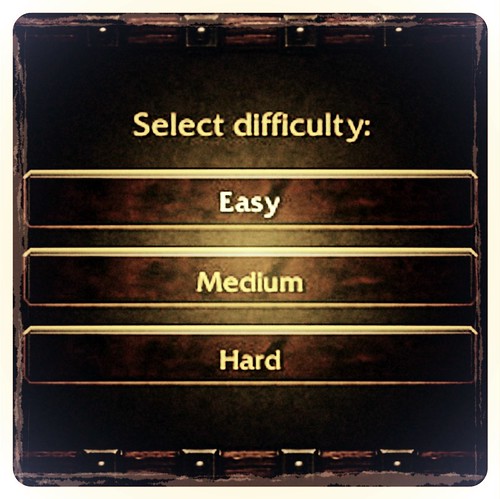
John Scalzi has, once again, put better thinking into something. He suggests that being a straight white male is like playing a video game at the lowest difficulty setting.
To which I say "exactly". That doesn't mean the game isn't difficult. It doesn't mean that other people, on higher settings, can't play. But there are lots of things much easier to play because of being an American white guy.
One reason is because I can't spell the word "privilege" worth a damn.
Which, to me, sets us back a whole step.
John Scalzi has, once again, put better thinking into something. He suggests that being a straight white male is like playing a video game at the lowest difficulty setting.
To which I say "exactly". That doesn't mean the game isn't difficult. It doesn't mean that other people, on higher settings, can't play. But there are lots of things much easier to play because of being an American white guy.
Thursday, May 3, 2012
Elective Influence
You know, even as a former union organizer, I've been opposed to the Employee Free Choice Act because it allows a union to bully workers into signing cards and not a secret ballot in order to make the union their bargaining agent.
Because the way I see it, why not just make elections happen faster?
Well, presumably they are now. Faster. Which means that the entire system is more fair. I mean, that seems to be the case on the face of it.
 I'm a big fan of the secret ballot. It works both ways -- the employer can't force you to vote one way or the other and the union can't either. In fact, in some cases there's more than one union trying to organize a workplace.
Because the way I see it, why not just make elections happen faster?
Well, presumably they are now. Faster. Which means that the entire system is more fair. I mean, that seems to be the case on the face of it.
Subscribe to:
Posts (Atom)